
The Guide · Issue 02
Buying a niche perfume blind is the most expensive way to find out you do not like it. A 100ml bottle from a serious house can cost the same as a weekend away, and unlike a weekend away, the bottle does not refund itself when the dry-down disappoints. The good news is that nobody has to buy that way anymore. The fragrance industry has built three serious ways to test a perfume before buying, and a fourth one specific to ÉCLATAUR. This guide walks through all of them, plus the four-step protocol that turns a tester into a confident purchase.
The most important truth in fragrance testing is the one nobody tells you in the store: a perfume on a paper strip is not the same perfume on your skin, and a perfume in the first thirty seconds is not the same perfume in the sixth hour. Learning how to test perfume before buying means learning to wait, learning to test on skin, and learning to limit how many you test in a session. Everything else follows from those three rules.
How to Test Perfume Before Buying: The Three Industry Approaches
Niche perfume houses have settled on three formats for letting buyers test before they commit. Each one solves a different problem, and each one has a different cost-to-confidence ratio. Knowing which is built for what saves money and time, and prevents the most common shopping mistake in the category: buying a 100ml bottle off a thirty-second strip in a store.
Paper Strips and Store Sampling
The fastest, cheapest, and least reliable. A paper blotter at a fragrance counter tells you only what the top notes smell like in the first thirty seconds. Useful for narrowing a category down to two or three contenders. Useless for deciding between them. Most niche houses recommend testing no more than three fragrances per session this way before olfactory fatigue dulls your nose.
Decants and Sample Vials
Small portions, usually 2ml to 5ml, decanted from full bottles by third-party retailers or directly by the house. Worn over several days. The first format that lets you experience the full top-heart-base arc on your own skin, in your own life, in your own weather. Decants are the industry standard for serious testing, but quality varies wildly when sourced from non-authorized sellers.
Discovery Sets and Tester Programs
A curated collection of small vials from a single house, designed to introduce a buyer to the full collection. Discovery sets and house-run tester programs solve the authenticity problem decants do not, because every vial comes directly from the perfumer. The best of these are also the lowest-friction way to commit a small amount of money to learning a brand’s voice.
Buy the experience, not the bottle. A perfume worth wearing is a perfume worth living with for a week before you commit to wearing it for a year.
Sample Vials vs House Testers: Which to Choose
Within the testing world, the most useful distinction is between a third-party sample vial and a house-run tester. They look identical at first glance and they cost roughly the same, but what you are actually buying is different in each case. Understanding the difference is the difference between testing a fragrance and testing a possibly-degraded copy of one.
Third-Party Sample Vial
- Source: Independent decanters who buy bottles and split them
- Authenticity: Variable, depends entirely on the seller’s sourcing
- Freshness: Depends on when the decant was made, how it was stored, what container it sits in
- Concentration: Should match the original, but no chain of custody
- Price: Often inexpensive, but the cheapest are often the riskiest
- Best for: Discontinued fragrances, exploratory shopping across many brands
House-Run Tester (e.g. The ÉCLATAUR Prelude)
- Source: Direct from the perfumer, same batch as the retail bottle
- Authenticity: Guaranteed by the house, no chain-of-custody questions
- Freshness: Filled from current production, sealed at the studio
- Concentration: Identical to the retail bottle
- Price: Comparable to a sample, often with a credit toward a full bottle
- Built for: Honest, low-risk evaluation of a house’s actual work
Four Things to Do When You Test Perfume Before Buying
Whichever format you choose, the testing protocol is the same. These four steps separate a real evaluation from a thirty-second guess. Done well, they take a single fragrance about a day. Skipped, they cost you the price of a full bottle that was wrong from the first wear.
Test on Skin, Not Paper
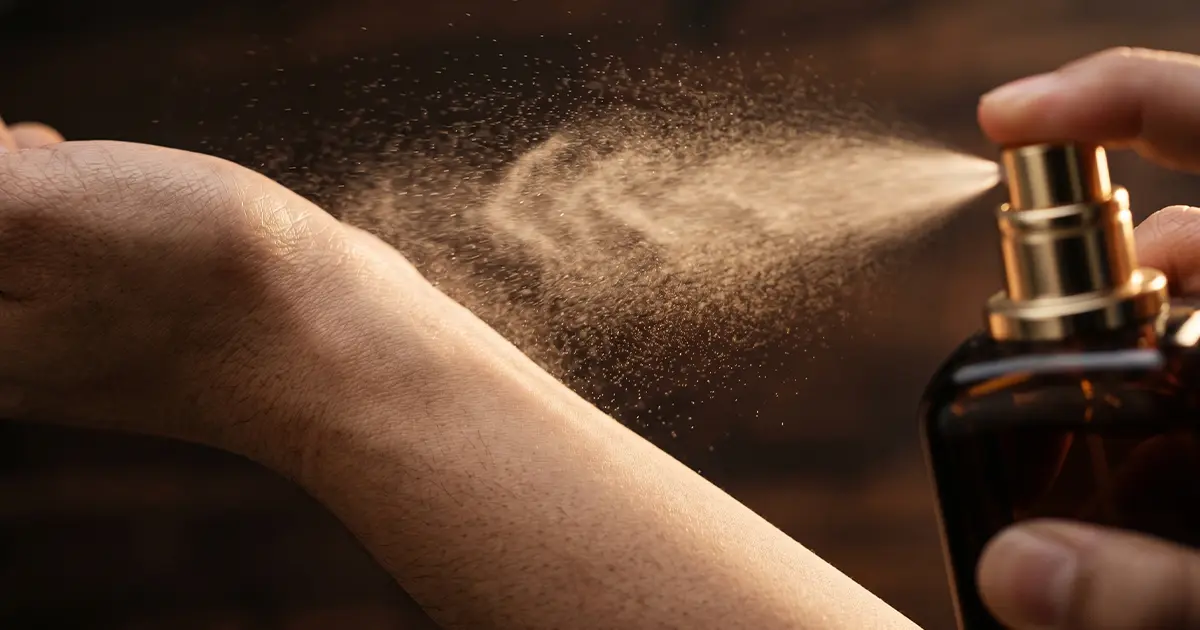
Paper strips show you the top notes only and miss everything that matters. Apply two sprays or a single roll to a clean wrist or inner elbow, ideally without scented moisturiser nearby. Skin pH, body heat, and natural lipids all change how a fragrance reads. A perfume that smells expensive on paper can smell wrong on you, and vice versa. The skin test is the only one that decides.
Wait at Least Six Hours
A fragrance unfolds in three acts. Top notes flash and fade in fifteen to thirty minutes. Heart notes settle in over the next few hours. Base notes anchor the scent for the rest of the wear. Decisions made in the first thirty seconds judge only the opening, which is the part of the perfume you will smell least over the day. Wait six hours. Wait twelve if you can. The dry-down is what you actually wear.
Test in Real Conditions
A fragrance behaves differently in a heated store, a cold morning, an air-conditioned office, an outdoor evening. If a perfume will live on your skin during your commute and your dinner, it should be tested during those moments, not under retail lighting. Wear the tester for a full day in your actual life. Conditions reveal compatibility that store sampling never will.
Limit Yourself to Three Fragrances
Olfactory fatigue is a real phenomenon. Your nose loses the ability to distinguish between scents after roughly three back-to-back evaluations. Coffee beans help reset, but the only real fix is restraint. Test no more than three fragrances per session, and never compare two complex compositions in the same hour. Spread evaluations across days. The slow path is the only path to a confident answer.
When to Use Each Testing Format
Different testing formats are built for different stages of the discovery journey. Knowing which to reach for at which moment saves wasted spending and shortens the path to a real signature scent.
Use Paper Strips for Categories
The first time you walk into a store or visit a brand’s website, you do not yet know what you like. Paper strips are perfect for this stage. They let you scan ten or twenty fragrances quickly to identify which families speak to you. Amber and oud, fresh citrus, white floral, gourmand. Once you have narrowed to one or two families, paper has done its job. Move to skin.
Use Decants for Single-Fragrance Deep Dives
When a specific fragrance has caught your attention and you want to live with it for a week before buying the full bottle, a decant or sample vial is the right tool. Buy from authorized resellers or the house itself. A 5ml decant gives you roughly twenty wears, enough to know whether the fragrance becomes part of you or fades into the background.
Use House Testers for Brand Discovery
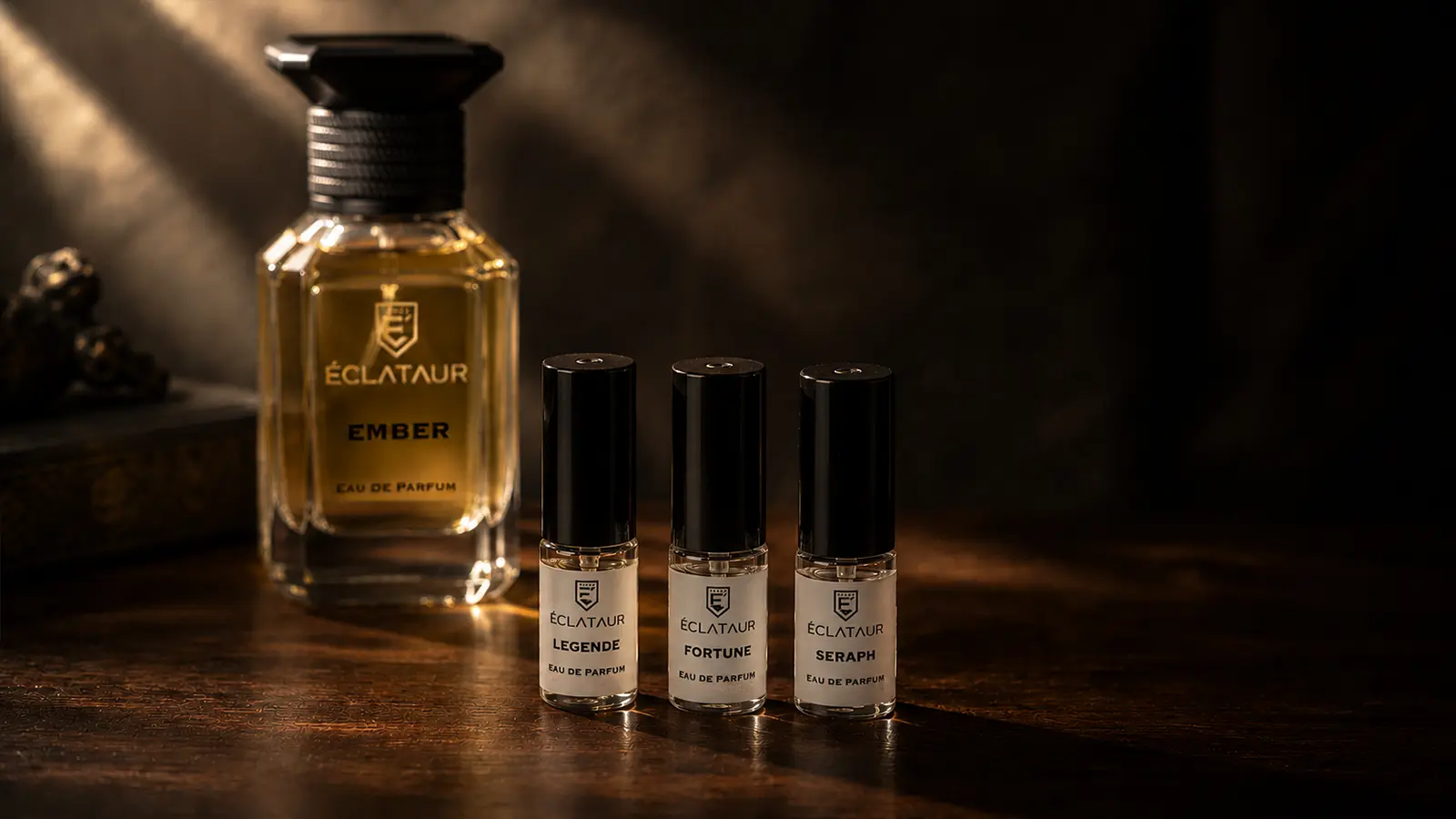
When you want to learn a perfumer’s full voice, not just one fragrance, a house tester program is the lowest-friction path. The ÉCLATAUR Prelude is built for exactly this. Each tester is filled from current production, sealed at the studio, and matches the retail bottle exactly. Try EMBER, CLARTE, and SERAPH in a single round, and you will know the house better than most full-bottle owners.
How ÉCLATAUR Handles Testing: The Prelude
ÉCLATAUR built its tester program around a single principle: the testing experience should be honest, generous, and identical to the bottle. The Prelude offers any fragrance in the collection as a sealed tester, filled from the same batch as the full bottle, after the same 30-day maceration window covered in our Maceration Perfume guide. Nothing about the Prelude tester is a stripped-down version of the real thing. It is the real thing, in a smaller format, built for the buyer who wants to wear the work before they own it.
For first-time visitors to the house, our recommendation is to start with two or three testers chosen from different scent families. EMBER is amber-saffron warmth, built for cold weather and evening wear. CLARTE sits in the bright-citrus territory, our most versatile composition for daily wear. SERAPH brings cocoa and white florals together in a way that surprises most wearers on first contact. Three testers, three families, three completely different commitments. After a week of testing, you will know which one you want as a full bottle, and you will have learned more about how perfume works than any number of paper strips would have taught you.
A note on language. The fragrance industry has historically borrowed terminology from Britannica’s reference work on perfume to describe the technical structure of a composition. Communities like Fragrantica have built decades of crowdsourced wear-data on top of that vocabulary. If you are new to fragrance, both are worth bookmarking before you order your first tester. The more you know about what a perfume is doing on your skin, the more useful your testing protocol becomes.
How to Test Perfume Before Buying – Your Questions Answered
Order a tester or sample vial directly from the house. Apply two sprays or a single roll to a clean wrist, wait at least six hours, and wear the fragrance through your normal day. Skin chemistry, body heat, and real-life conditions reveal what no in-store sniff or product description ever can.
Minimum six hours per wear. Ideally a full day, repeated across two or three different days. Top notes fade in thirty minutes, heart notes settle in over the first few hours, and base notes carry the rest of the wear. Decisions made in the first hour judge only the opening, which is the part you will smell least.
No. Sample vials are usually decanted by third parties from full bottles and the chain of custody varies. House testers come directly from the perfumer and match the retail bottle exactly. Both are useful, but only a house tester guarantees the fragrance has not been compromised by improper storage or repackaging.
Three at most, on paper strips, before olfactory fatigue dulls your nose. On skin, only one fragrance per day. Coffee beans can help reset between paper tests, but the cleanest evaluations come from spacing tests across multiple days. Restraint matters more than speed when you are deciding what to wear long-term.
Skin chemistry. Your skin pH, hydration level, body temperature, and natural lipids all interact with the aromatic molecules in a fragrance. Two people wearing the same perfume can experience genuinely different scents, especially in the heart and base notes. This is why testing on your own skin is non-negotiable.
The Prelude is ÉCLATAUR’s house tester program. Every tester is filled directly from current production, sealed at our Sunnyvale studio, and matches the retail bottle exactly in concentration, maceration, and accord. Unlike third-party sample vials, there is no chain-of-custody question. You wear what we make, before you commit to the full bottle.
Test Before You Commit
Every ÉCLATAUR fragrance is available as a Prelude tester, filled from the same batch as the full bottle and rested for the full 30-day maceration window. Begin with one tester, or build a small collection across scent families. The fragrance is the same. Only the format is smaller.
