Skip to content

The Craft Series Issue 03

The VELUM System: How Fifteen Layers Hold a Fragrance

A perfume longevity system is not one ingredient that makes a scent last. It is an architecture: materials chosen so that as each one fades, another is already rising underneath to take its place.

The VELUM System: How Fifteen Layers Hold a Fragrance

A perfume longevity system is not one ingredient that makes a scent last. It is an architecture: materials chosen so that as each one fades, another is already rising underneath to take its place. Done badly, a fragrance falls off a cliff at hour three. Done well, it steps down so gradually that the wearer never notices a transition, only that it is still there at the end of the day.

Every spray in this collection is built on the same fifteen layer base accord, called VELUM, and every one of them is engineered to hold for ten hours or more. This is an account of what that structure is doing, and, just as importantly, what it is not.

What a Perfume Longevity System Actually Is

The instinct is to imagine longevity as strength. Add more concentrate, get more hours. That is true up to a point and then it stops being true, because the materials that carry a fragrance’s opening are the same materials that will not stay.

Volatility is the governing property. Aromatic molecules leave skin at rates that vary by orders of magnitude, decided largely by molecular weight and vapour pressure. Citrus and light aldehydes are gone in minutes. Florals and spices hold for a few hours. Resins, woods and musks can persist on fabric for days. A composition is a sequence of these departures, which is why perfumery describes a scent in three acts rather than one smell.

0 to 30 minutes

The Opening Leaves

The lightest materials evaporate first and are largely gone within the half hour. This is by design and not a fault. Every fragrance in this collection states the same window, because the physics does not negotiate: citrus and pepper are bright precisely because they are volatile.

30 minutes to 5 hours

The Heart Carries

The middle of a composition does the longest stretch of visible work, and it is where most fragrances fail. If nothing is rising underneath as the heart thins, the scent reads as fading rather than changing, and the wearer reaches for the bottle again by mid afternoon.

5 to 10 plus hours

The Base Holds

Heavy materials with low vapour pressure stay on skin and cloth long after everything above them has gone. They also slow the departure of lighter molecules bound to them, which is the mechanism people are describing when they say a base fixes a fragrance.

A fragrance does not end. It hands over, again and again, until there is nothing left to hand to.

Why Fifteen Layers Rather Than One Fixative

A single heavy fixative will make a fragrance last. It will also flatten it. Load enough musk or ambroxan underneath a composition and the scent survives the day, but it converges on the fixative: by hour four, most of what remains is the thing holding it up rather than the thing being held.

Layering is the answer to that problem. Instead of one material carrying the whole load, the VELUM accord distributes it across fifteen, each with a slightly different volatility, so that the handover from one to the next happens continuously rather than in steps. The wearer experiences this as a scent that changes character without ever seeming to drop.

The materials themselves are not exotic, and the collection is open about them. Across the twenty fragrances, white musk appears in eleven base accords, Virginian cedar in seven, Madagascar vanilla and tonka bean in six each, ambroxan in five, and labdanum and sandalwood in four. What differs between one fragrance and the next is proportion and pairing, not the existence of a secret ingredient.

Layered

A Continuous Handover

Fifteen materials at graded volatilities mean something is always rising as something else falls. The composition keeps its shape through the whole wear, and the last hour still smells like the fragrance rather than like its scaffolding.

Single fixative

A Long Flat Tail

One heavy material does hold the wear, and it is the cheaper route. The cost is character: the fragrance narrows toward the fixative as the hours pass, which is why so many long lasting scents end up smelling like each other by evening.

There is a practical consequence to this that wearers notice without knowing why. A layered base does not smell the same at hour eight as it does at hour two, and it is not meant to. What should stay constant is the character: an amber should still read as an amber, a gourmand should still read as sweet rather than merely warm. When a fragrance loses its direction as it fades, the base was carrying it instead of supporting it.

What the Structure Cannot Do

Longevity is the most oversold property in fragrance, so it is worth being exact.

A base accord cannot make a fragrance project all day. Projection and longevity are separate properties and they follow different curves: the collection states strong projection for roughly the first three to four hours, after which a fragrance settles closer to the skin and becomes a trail rather than an announcement. That is not the scent weakening. It is the difference between what others notice across a room and what remains detectable within arm’s length, and no structure changes it.

It cannot overcome skin. Dry skin holds fragrance poorly because there is less oil for the materials to bind to, and the same spray will read shorter on one person than another. This is the single most common reason two people disagree about how long a bottle lasts, and it is covered properly in the longevity guide.

It cannot be judged on paper. A test strip has no warmth, no oils and no chemistry, so it shows the opening and almost nothing else. Anyone assessing a base accord from a card in a shop is assessing the one part of the fragrance the base is not responsible for, which is why testing on skin is the only method that answers the question.

And it cannot compensate for a rushed batch. A blend that has not been given time to settle presents unevenly no matter how well the base is built, which is the argument of the maceration standard and the reason every batch rests thirty days before filtration.

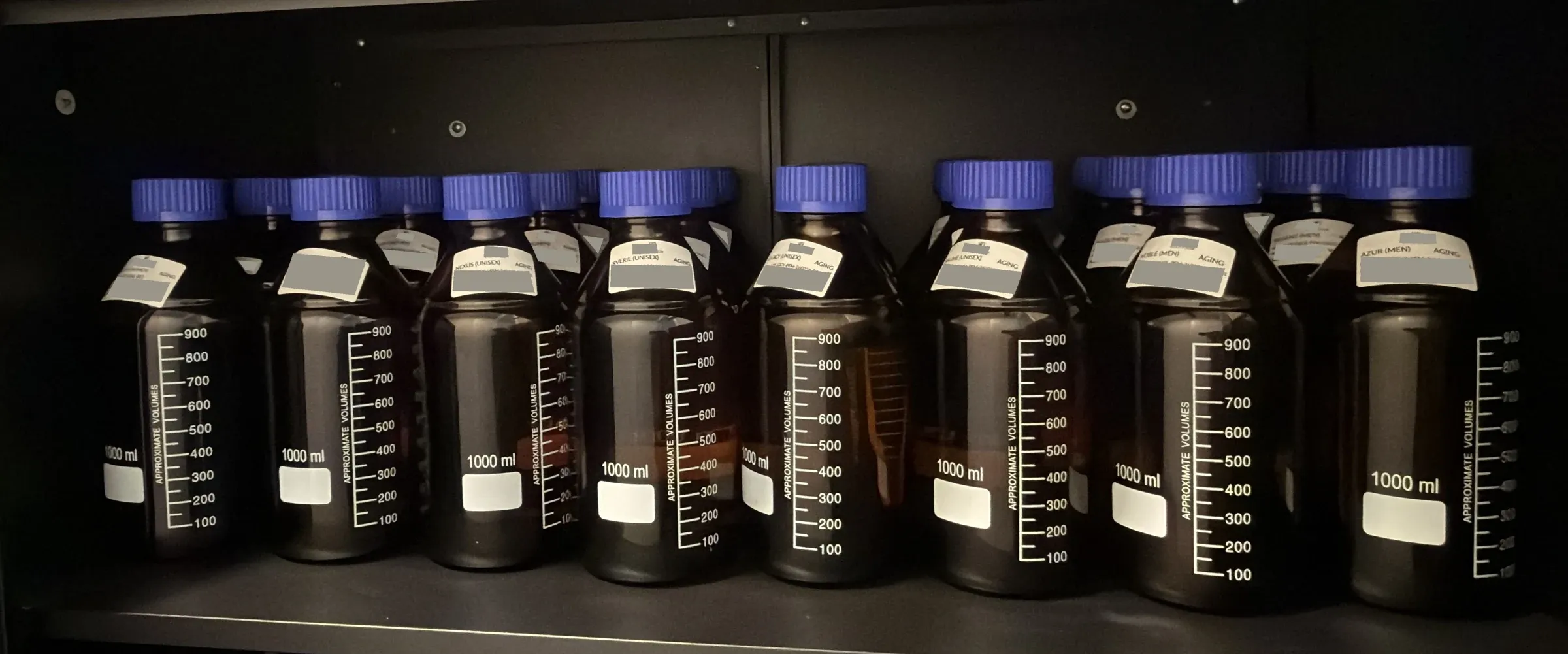
Working solutions resting in labelled amber glass in the atelier cabinet

The Same Structure, Different Buildings

Because the layering is a method rather than a recipe, it produces very different results depending on what sits above it.

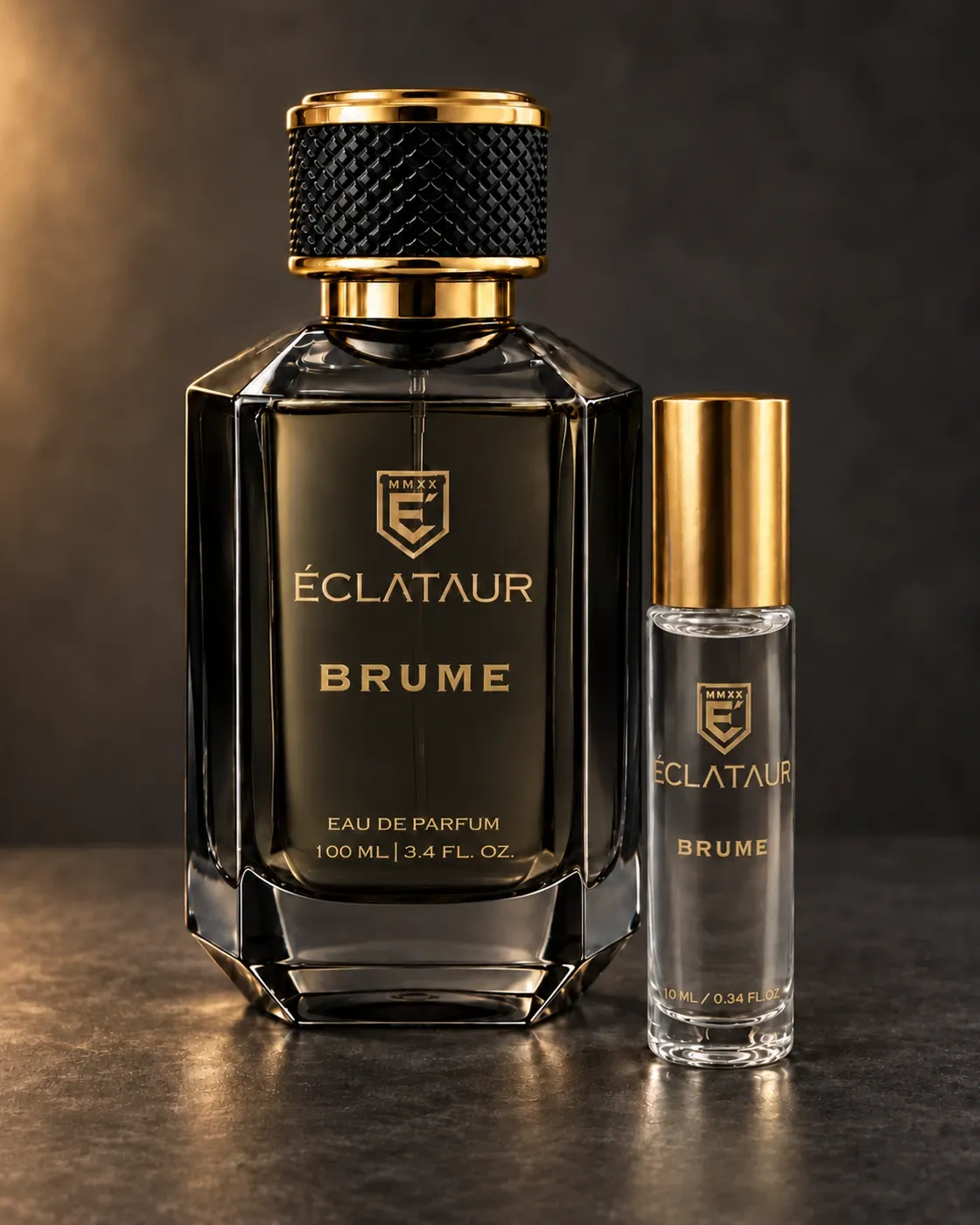
CLARTE rests on white musk, tonka bean, Madagascar vanilla, cedarwood and labdanum, which is why an amber musk that opens bright on bergamot and pink pepper still reads warm and close ten hours later. BRUME uses its base to hold an oriental woody character that behaves like incense in a closed room, present long after the opening has gone. SUNLATTE puts the same principle under a gourmand, where the risk is not fading but cloying, and the layering is what keeps the vanilla from collapsing into sweetness by hour six.

The roll-ons take a different route to the same place. An oil has no alcohol to carry it outward, so it projects far less and sits against the skin from the first minute, which makes the base accord’s work more intimate and, for some wearers, longer felt. The trade is reach for closeness, and the guide to perfume oil versus spray sets out when each is the right choice.

If a composition’s direction matters more to you than its endurance, fragrance families is the better place to start, since no amount of structure will make an amber suit someone who wants a citrus.

For general background on how perfumes are constructed and classified, Britannica’s entry on perfume is reliable, and Fragrantica is the most useful public record of how compositions actually behave on the people wearing them.

Perfume Longevity System: Your Questions Answered

What is a perfume longevity system?

It is the base architecture of a fragrance: the set of heavier materials that stay on skin after the opening has evaporated, arranged so they release in sequence rather than all at once. ÉCLATAUR calls its own fifteen layer version VELUM, and every spray in the collection is built on it.

How long does ÉCLATAUR fragrance last?

Every spray is built to hold for ten hours or more, with strong projection through roughly the first three to four hours before it settles into a closer trail. Skin type, weather and where you apply it will move that figure in either direction.

Does higher concentration mean longer lasting perfume?

Only partly. Concentration sets how much aromatic material is present, but the duration depends on which materials they are. A high concentration built entirely on volatile top notes will still be gone by lunchtime, while a well structured base at a lower concentration can run all day.

Why does perfume last longer on some people than others?

Skin oil is the main variable. Fragrance materials bind to the oils in skin, so drier skin releases them faster and a scent reads shorter. Body temperature and pH play smaller parts. Applying to moisturised skin is the single most effective correction.

What is the difference between projection and longevity?

Projection is how far a fragrance travels from the wearer; longevity is how long it remains detectable at all. They peak at different times. A scent commonly projects strongly for the first few hours and then continues for many more as a trail readable only up close.

Do fixatives make perfume smell cheaper?

Not the materials themselves, which are standard across fine perfumery. The problem is proportion. Leaning on one heavy fixative to carry the whole wear narrows a composition toward that single material, which is why many long lasting fragrances converge on a similar dry down. Distributing the load across many layers avoids it.