Skip to content

The Craft Series Issue 02

The Perfume Alcohol Base: Why 200 Proof Matters

The perfume alcohol base is the least discussed ingredient in any bottle and usually the largest. It carries the oils, sets the opening, and decides whether a composition arrives clean or arrives muddled.

The Perfume Alcohol Base: Why 200 Proof Matters

The perfume alcohol base is the least discussed ingredient in any bottle and usually the largest. It carries the oils, sets the opening, and decides whether a composition arrives clean or arrives muddled. In an Eau de Parfum at 20 to 25 percent concentration, roughly three quarters of what leaves the atomiser is carrier. Everything a wearer notices in the first thirty seconds passes through it.

Perfume conversation tends to begin at the notes and stop there. Bergamot, saffron, tonka: the list is the romance. But a note list describes what was added, not what happens when it is worn, and the material doing most of that work is the one nobody puts on the box.

What the Perfume Alcohol Base Is Doing

Alcohol in a fragrance is a solvent and a delivery system. Aromatic materials are, for the most part, oils. They do not disperse into air on their own at any useful rate, and applied neat they sit in a slick on the skin, releasing slowly and unevenly from wherever they happen to land. Alcohol dissolves them, spreads them across a wide surface, and then leaves.

That departure is the point. Ethanol evaporates within seconds of meeting skin, and as it goes it lifts the lightest molecules with it and distributes the rest in a thin, even film. What a wearer calls the opening of a fragrance is largely the sound of the carrier leaving.

It Dissolves

Aromatic oils are not mutually soluble in water and will not disperse alone. Ethanol holds resins, absolutes and synthetics in one stable solution, so a composition stays a composition rather than separating into layers between one wearing and the next.

It Distributes

A spray atomises because the liquid is thin enough to break into droplets. That is the carrier's doing. It spreads a few drops of concentrate across a hand's width of skin in an even film, which is why sprayed fragrance reads as a cloud and oil applied by hand reads as a point.

It Leaves

Ethanol is gone from the skin in well under a minute, taking the most volatile top notes with it on the way out. What remains is the heart and base, sitting where the carrier placed them. A clean departure is as important as a clean arrival.

A fragrance is only as clean as the thing carrying it. Everything else is arithmetic.

Why 200 Proof, and Why Organic Grain

Two numbers govern a perfumer’s carrier: how pure the ethanol is, and what it was distilled from. Both are decisions a house makes long before a note list exists, and both are invisible on the finished bottle.

Proof is a measure of water content. Two hundred proof means the ethanol has been dried to as close to anhydrous as production allows. Anything below that carries water, and water in a fragrance base is not neutral: it lowers the solubility of the heavier resins and absolutes, which is the mechanism behind a perfume that turns cloudy in cold weather or leaves a faint residue on a shirt cuff. A drier base holds more material in solution and holds it more stably across the temperatures a bottle will actually meet.

The feedstock matters for a different reason. Ethanol can be distilled from grain, from cane, from grape, from beet, or synthesised from petrochemical feedstock. All of them yield the same molecule. They do not all yield the same smell, because distillation is never perfectly selective and trace congeners survive the process. A base carrying its own faint sweetness or grassiness is a base that has an opinion about every fragrance built on it.

What ÉCLATAUR uses

Organic Grain, Undenatured

Food grade, non-denatured, distilled from grain and dried to 200 proof. Undenatured means no bittering agent or solvent has been added to make it undrinkable for tax purposes. Those additives have smells of their own, and a house that uses them has accepted a permanent note it did not compose.

The common alternative

Denatured, Lower Proof

Cheaper per litre and entirely legitimate, which is why most of the market runs on it. It carries residual water and a denaturant, and both make themselves known in the first minute of wear as a sharpness the composition has to be built to hide.

The Carrier and the First Thirty Seconds

Most complaints about a fragrance are complaints about its opening. It smells harsh. It smells like alcohol. It smells nothing like it did on the card. In a large majority of cases the composition is not at fault; the carrier is still evaporating, and it is being heard.

This is where the base and the resting period meet. A freshly blended perfume smells sharp because the ethanol has not yet formed stable associations with the aromatic molecules around it, and sits on top of them rather than among them. Time fixes this, which is the entire argument of the maceration standard and the reason every batch here rests thirty days before it is filtered.

A drier, cleaner carrier shortens the distance that resting has to travel. It arrives with less to mellow. The two decisions compound: a good base rested properly produces an opening that is recognisably the fragrance rather than a preamble to it.

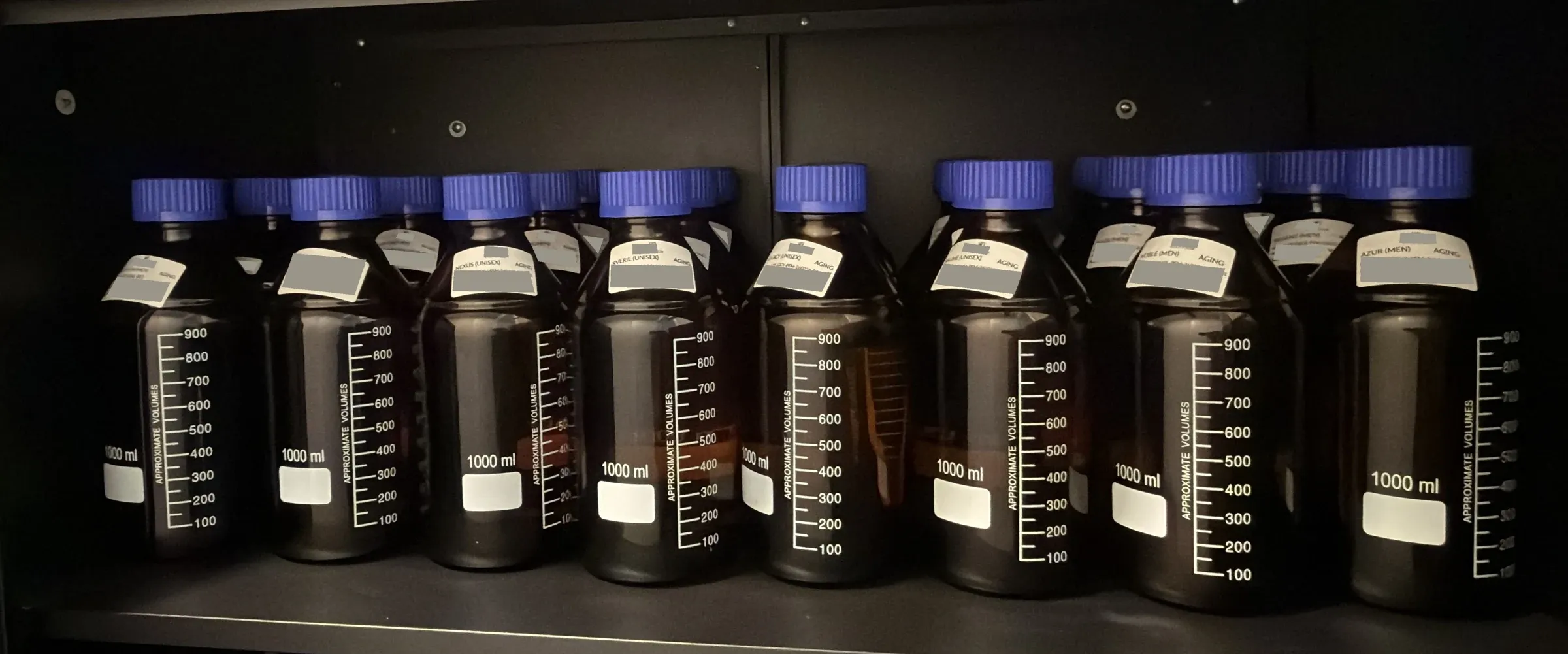
Working solutions resting in amber glass on the atelier shelf, labelled and dated by hand

What the Base Cannot Do

It is worth being exact about the limits, because carrier quality is easy to oversell.

A better base will not make a fragrance last longer in any meaningful sense. Longevity is decided by the heavy materials in the base accord and by how much of them a formula carries. Every spray in this collection is built to hold for 10 plus hours, and that figure comes from the composition, not the carrier. What the alcohol decides is how cleanly the wearer arrives at those hours.

Nor will it rescue a thin formula. A composition with nothing underneath it will still disappear by lunchtime on the finest ethanol available, which is a point the longevity guide treats at length. And it will not change the direction of a scent: an amber is an amber, and the carrier has no vote in whether that suits the person wearing it. That question belongs to fragrance families.

What it does decide is honesty of presentation. On a clean base, a composition smells the way it was built to smell from the first second. CLARTE opens on bergamot and pink pepper because that is what is written into it, not because a sharpness has been arranged to cover something. The same holds for the bergamot opening of REGENT and the citrus of LUCIDE, both of which are built on top notes that a wet or denatured carrier would trample on the way out.

How a Wearer Can Tell

None of this is visible, and a customer is right to be sceptical of a claim they cannot check. There are, however, two honest tests.

The first is the opening. Spray onto skin, not paper, and pay attention to the first twenty seconds rather than the first two. A carrier that is doing its job recedes and leaves the composition standing. A carrier that is not stays present as a distinct sharpness that has to fade before the fragrance begins.

The second is the cold. Leave a bottle somewhere genuinely cool overnight and look at it in the morning. A base carrying water will often show a faint haze as the heavier materials come out of solution, and it may not fully clear. This is not a defect in the perfume and it does not make it unsafe. It is simply the carrier showing its work.

Both tests need skin and time, which is what testers are for. The Prelude exists so this can be done at low commitment rather than on the evidence of a paper strip in a shop, and the testing guide sets out the protocol.

For a broader account of how perfume is constructed, Britannica’s entry on perfume is a sound starting point, and Fragrantica remains the most useful public reference for how individual compositions are read by the people wearing them.

Perfume Alcohol Base: Your Questions Answered

What alcohol is used in perfume?

Nearly all modern fine fragrance uses ethanol, usually at a high proof so that it carries as little water as possible. Houses differ in what the ethanol was distilled from and whether it has been denatured. ÉCLATAUR uses 200 proof organic, food grade, non-denatured grain alcohol in every spray.

What does 200 proof mean in a perfume alcohol base?

Proof is twice the alcohol percentage by volume, so 200 proof is as close to pure ethanol as production allows, with essentially no water. A drier base holds heavy resins and absolutes in solution more reliably, which matters most in cold conditions where a wetter base can turn hazy.

Does the alcohol in perfume make it last longer?

No. Longevity comes from the heavier materials in the base accord and how much of them a formula carries. The carrier evaporates within a minute of application. What a better base changes is the quality of the opening, not the length of the wear.

Why does my perfume smell like alcohol at first?

Because the carrier is still evaporating and you are smelling it leave. It is more pronounced when the base carries water or a denaturant, and when the fragrance has not been rested long enough for the ethanol to settle among the aromatic molecules. A properly macerated fragrance on a dry base has a much shorter version of this phase.

What is denatured alcohol and why does it matter in fragrance?

Denatured alcohol has had an additive introduced to make it undrinkable, usually so it can be sold without beverage duty. The additives are legitimate and safe on skin, but they are not odourless, so the composition has to be built around a smell the perfumer did not choose. Undenatured bases avoid that compromise.

Is alcohol free perfume better for skin?

Not inherently, though it behaves differently. Oil based fragrance sits closer to the skin, projects far less, and suits people who find the evaporation of a spray drying. It is a different format rather than a superior one, which the guide to perfume oil versus spray covers in full.